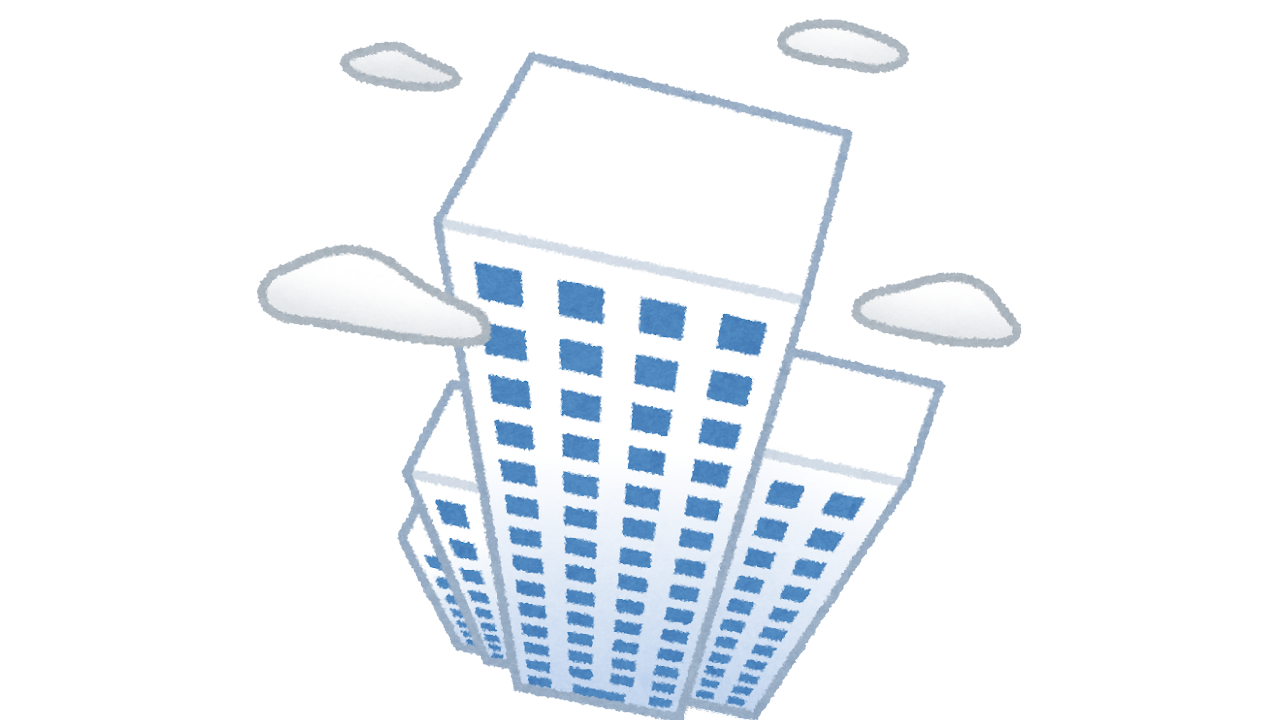
As the title suggests, this article is about my recent move.
So, about a month ago, I moved into a tower apartment that’s over 100 meters tall. Seriously.
In this post, I’ll share the story behind the move and my impressions after living there for about a month.
Why I Moved to a Tower Apartment
I’m sure everyone’s curious about this.
You might be thinking “millionaire” or “aristocat” — I’ve seen all the Twitter (X) comments. But the decision came down to one simple fact: after considering all my requirements, this place was actually cheap.
What were those requirements? Here’s what I prioritized:
- 2LDK layout
- Within 10 minutes walk from a station (preferably a major one)
- Reinforced concrete (RC) construction
- 2nd floor or higher
- Camera intercom and auto-lock security
- High-speed internet
- Affordable rent (keeping exact figures private to avoid being identified)
This apartment checked every box except #6, making it a pretty solid deal in my book.
Conversely, most apartments that met nearly all these criteria required compromising on #7 (rent), which was tough on my budget.
So when I found a place that satisfied my entire wish list, this was it. That’s the whole story.
Not Your Typical Glamorous Tower Apartment
Tower apartments have been getting a lot of attention lately, but this isn’t one of those sleek modern buildings you see all over social media.
There’s no gym, no lounge, no guest rooms — it’s a no-frills building that’s over 20 years old. (LOL)
Think of it as a regular apartment building that just happens to be really tall — an aging tower apartment. Please keep that in mind.
(If it were anything fancier, there’s no way I could afford it.)
On the Aging Tower Apartment Problem
I’m renting here as a “bunjo chintai” (renting a unit in a condominium building), where most units were originally purchased as permanent residences.
With that context, let me touch on the “aging tower apartment” issue that’s been making headlines lately.
More Young Residents Than Expected
As the heading suggests, I was surprised by how many young people live here.
You’d expect that people who bought new units 20+ years ago at age 40-50 would now be in their 60s-70s. But there seems to be quite a bit of turnover.
Despite concerns about tower apartments turning into vertical housing projects, that’s not the case here — residents span all age groups.
It seems that original buyers are cashing in on the recent condo boom price surge, while younger buyers in their 20s-30s who can’t afford new construction are snapping up these units.
(That said, you still need at least around 50 million yen…)
The Financial Side
The “aging tower apartment” discussion always comes with talk about maintenance reserve funds.
Since I’m just renting, I don’t have full visibility into the financials, but here are some things I noticed:
- The building uses bulk electricity purchasing to save even a single yen on common area power costs.
- The underground mechanical parking has been converted to flat surface parking.
- Elevator maintenance is handled by a third-party company (not the original manufacturer), and some replaced elevators are from lesser-known brands.
- The major railway-affiliated real estate company that originally sold the units is no longer involved in management.
These four points suggest the building is under significant financial pressure.
Points 1 and 2 are common across many apartment buildings.
Point 3 strongly suggests cost-cutting. I wouldn’t be surprised if the next major renovation includes budget elevator replacements for the resident elevators too.
Point 4 is fairly unusual. The original developer has stepped away, and the management association has hired a local maintenance company instead.
You can really feel the effort to cut costs wherever possible. But since I’m just renting, if things deteriorate too much, I’ll just move out — so I’m watching from a comfortable distance.
Living in a 20+ Year Old Building: What I Noticed
Now for the unit itself. While the apartment has been periodically renovated, here are my observations:
- VDSL internet…
- Low ceilings in the bathroom and washroom
- The windows are cold
- The windows are cold
- The windows are cold
- Don’t need the tatami room
Let me break these down.
1. VDSL Internet
Given the building’s age, this is unavoidable. In fact, I’d say VDSL is actually the better option here.
Buildings from around 2005-2010 often featured “LAN wiring” as a selling point.
While LAN wiring sounds great, if it was done with Cat 5 cable, you’re capped at 100 Mbps.
Even worse, some buildings ran a single Cat 5 cable from the MDF (wiring room) to each floor, then distributed it to individual units via switching hubs. Absolute nightmare.
By comparison, phone lines can theoretically deliver up to 1 Gbps using G.fast technology, which is far more future-proof.
(Note: G.fast service in Japan currently caps at 633 Mbps.)
(G.fast hasn’t actually been deployed at my building yet, but I’ve been told it’s coming, so I signed up for NURO Hikari in anticipation.)
Point 3 is a well-known issue even in modern luxury tower apartments.
If we’re serious about SDGs and energy efficiency, aluminum window frames should be banned. Seriously.
(I understand they’re needed for storm protection, but at least apply a resin coating.)
Point 6 is about the traditional Japanese-style room that’s rarely seen in modern apartments.
Real estate agents say young renters tend to avoid units with tatami rooms or wall-to-wall carpet. So if you’re an owner looking to attract tenants, consider converting the tatami room to a Western-style room and replacing carpet with hardwood flooring.
In my unit, I’ve already removed the shoji screens and put up curtains. I’m planning to lay wood-look carpet tiles to give it a Western-style makeover.
There Are Plenty of Positives Too
I’ve been pretty negative so far, so let me highlight the good points:
1. 24-hour on-site management and security staff / front desk service / AED available
2. Since it’s a condo, the resident quality is generally high
3. Common areas are well-maintained and clean
4. Trash can be taken out 24/7, not just on collection days
5. Beautiful views from the top floor
I won’t go into detail on everything, but point 4 is something I find especially convenient.
Cardboard boxes from overseas online shopping that might contain bedbugs, food waste — I can toss it all immediately. It’s genuinely convenient.
If you hate dealing with garbage collection schedules, living in a building with 24/7 trash disposal is a game-changer.
No more running after the garbage truck every morning! (LOL)
So, Am I Satisfied Overall?
The short answer: very much so. The building is getting old, sure, but the solid construction and well-maintained services make it feel like a great deal.
Since 2LDK units are quite rare, you might achieve similar satisfaction by targeting condominium rentals even if they’re not in tower buildings.
Since you read all the way through, I’ll share a little secret: after factoring in my company’s housing allowance, my rent is actually below the Tokyo average for single-person apartments. (Including management fees.)
I plan to stay here for a while and save up for building my own place someday.
(Honestly, lower floors in new tower apartments are a genuinely great deal.)
Thanks for reading through all of this!

Leave a Reply