
This article covers my visit to a pre-launch event where you could try the Pixel 3 before it went on sale.
Fair warning: if you’re planning to attend this event yourself, this article contains spoilers — you might want to skip it. If you can’t make it due to distance but are curious, read on.
Also, I realized after writing this that I ended up focusing almost entirely on the Pixel 3 itself (and mostly the negatives), so if you want event coverage, I’d recommend checking other sites.
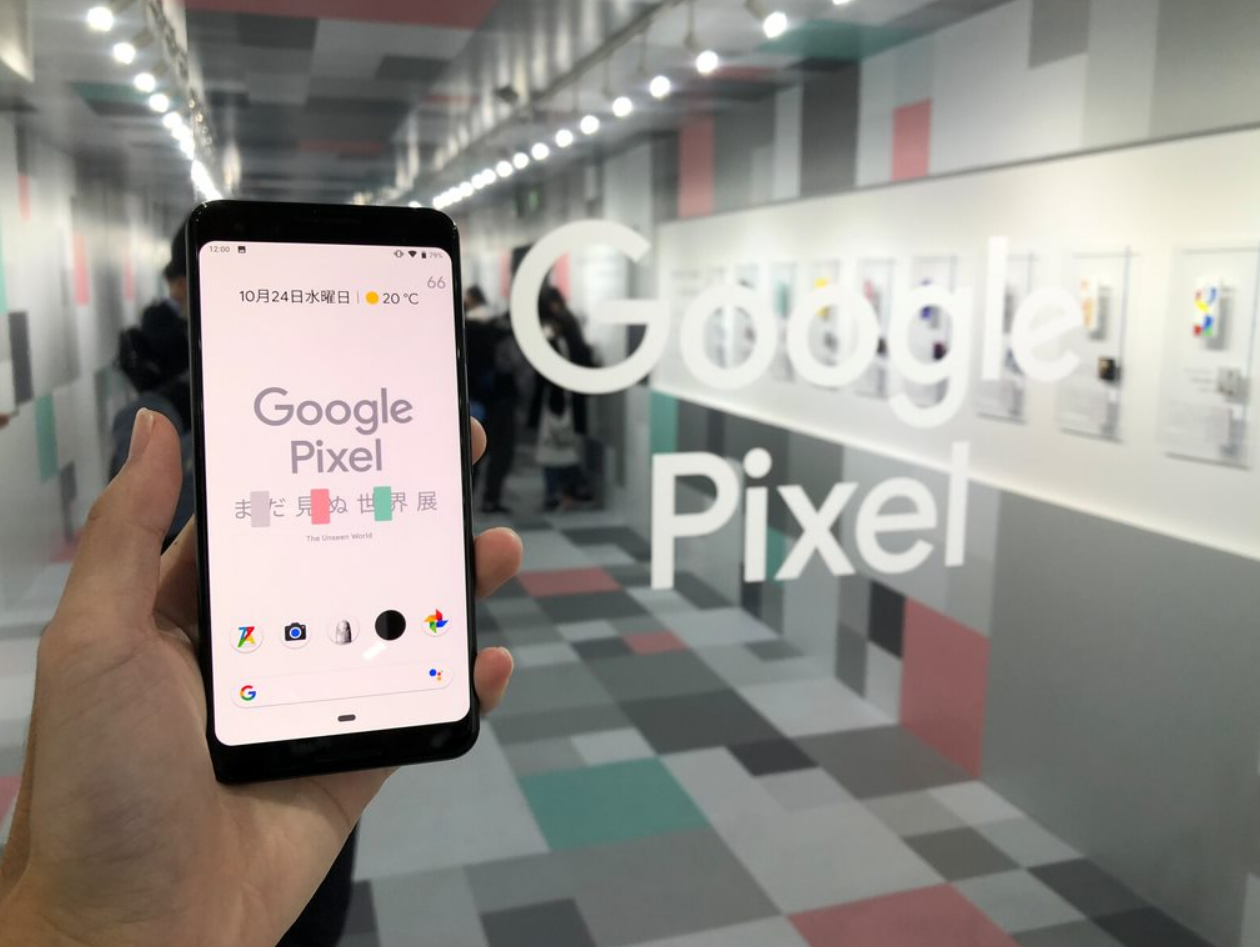
About the Google Pixel Unseen World Exhibition
This event, hosted by Google, let attendees try the Pixel 3 — announced at the recent “Made by Google 2018” event — before its official launch. The fact that Google held such an event in Japan shows they’re serious about breaking into the Japanese market this time around.
That’s the brief explanation. Moving on.
Event Date and Location
Dates: October 20 – 28, 2018, 11:00 – 20:00
Location: Shimizu Building, 3-5 Kita-Aoyama, Minato-ku, Tokyo 107-0061 (nearest station: Omotesando)
Hands-on Experience
I visited on the morning of October 24.
Here’s what the exterior looked like.
It’s located directly in front of the Omotesando Station A3 exit (in front of the police box).
A young man outside the building directed me inside. While waiting briefly, he handed me a book featuring the people involved in developing the Google Pixel 3. I only had time to skim it, but it was quite interesting. Several Japanese developers were involved in this generation.
Upon entering, they handed me a cardboard frame and a Pixel 3 right away.
Unlike the Galaxy Studio, which required a government-issued ID and signing a terms agreement to borrow a Galaxy S9, the Google Pixel Unseen World Exhibition had zero paperwork required.
While waiting for my guided tour, I played around with the Pixel 3. Here’s how it compares to my main phone, the iPhone X:
The physical dimensions are remarkably similar, but the Pixel’s larger bezels mean less display area:
Google Pixel 3: 145.6mm x 68.2mm
Apple iPhone X: 142.6mm x 70.9mm
That said, the front-facing stereo speakers make it a better choice for video watching.
One thing that’s been bugging me since the Pixel 2 — doesn’t this part look a bit off?
The curve of the body corners and the display corners are noticeably mismatched, creating an awkward visual disconnect. The Galaxy S8/S9 have a similar mismatch, but theirs is far less pronounced. I hope they fix this in the next Pixel.
Regarding the back panel, the Pixel 3 features “etched glass” — a world-first for smartphones. It offers an aluminum-like matte finish and strong fingerprint resistance. However, I noticed it seemed prone to scratching. After just 3 days of display use, visible scratches had already appeared that couldn’t be wiped away. If you don’t want scratches, skip the caseless life.
On the 2F, they introduced the design philosophy. The Pixel 3 comes in two sizes (Pixel 3 and Pixel 3 XL) and features Active Edge (ported from HTC’s Edge Sense) — squeeze to launch Google Assistant. Google Assistant is leagues ahead of Siri and truly leverages Google’s big data capabilities.
They also introduced the newly Japanese-compatible Google Lens. Point the camera at anything and it identifies it — genuinely impressive. It even recognized my Apple Watch and iPhone X.
The 3F focused on camera features. The Pixel 3 has dual front cameras with wide-angle and standard lenses, fitting up to 10 people in a selfie without a selfie stick. The portrait mode’s background blur was decent but occasionally looked unnatural.
Sample photos from the Pixel 3’s rear camera:
While I loved the camera output from the original Pixel and Pixel 2, the Pixel 3’s photos felt “overall dark.” Colors were natural without excessive processing, but the darkness dragged down the overall impression. Hoping for a software update to fix this.
The 4F was an ARCore demo. The spatial recognition was impressive. Battery dropped 12% in 30 minutes of heavy AR use — reasonable. The device only got mildly warm despite running Snapdragon 845, suggesting Google’s optimization is solid.
On the way out at 1F, they gave me a drink and a QR code for downloading photos taken with the Pixel 3. I chose the strawberry drink.
Verdict
Personally, it fell slightly below my expectations, though it’s still a good phone. Perhaps I overhyped it for myself.
The pricing feels a bit steep for the specs, but the target audience — people who want the fastest updates and pure AOSP — will find it worthwhile. I’ll probably buy one before year-end.
Whether it will appeal to the masses is debatable. As a carrier store employee pointed out, there aren’t enough compelling reasons to choose the Pixel 3 over an iPhone, Galaxy, or Xperia. The camera is the main selling point, but competitors are investing heavily in cameras too.
I suspect it will struggle in the Japanese market. That said, given Japan’s increasingly limited Android options, Google’s re-entry into the Japanese market is a welcome development. App developers can breathe easier, and enthusiasts like me who want the latest Android version ASAP are thrilled.
I’m sorry this article ended up being mostly negative. But make no mistake — despite its shortcomings, the Pixel 3 is genuinely a great device. Just go in with your eyes open about the issues mentioned here.
![[Preparation] Running Windows 10 on ARM on the Lumia 950 XL](https://miyagadget.page/wp-content/uploads/2019/02/kQ6Lm44l.jpg)
Leave a Reply